


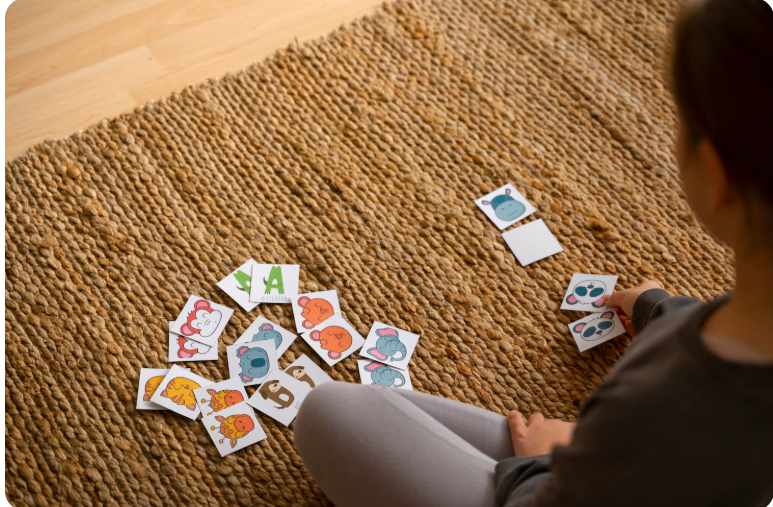
Your child can benefit greatly from activities that build focus and concentration. Playing different types of games, especially memory games, can help them develop these skills in a fun and stress-free way.
Thoughtfully selected memory games for kids can even support children with mild cognitive challenges, all while keeping playtime enjoyable and positive. This blog lists a few memory games for children to enjoy at home, in school, or outdoors.
Engaging Memory Games For Kids That Strengthen Children’s Brains
- Memory Match Cards
In Memory Match Cards, pairs of matching pictures are turned over, and the player must remember where the pair is located. As players play the game, they will continue to flip over cards looking for matching pairs. The activity helps build attention to detail and the child learns how to focus. Memory Match Cards can be played using small or large sets, depending on each child’s comfort level.
- The Tray Observation Game
The Tray Game is an easy activity you can set up at home using everyday household items. Simply arrange a few objects on a tray, let your child look at them for a short time, and then cover the tray. Your child then tries to remember and name as many items as they can. The activity is beneficial for enhancing visual memory and improving focus on the shapes, colors, and alignment of objects.
- Picture Bingo
Picture Bingo replaces numbers with recognizable images. Participants listen for the names of the pictures that are called out, and look for those pictures on their bingo card. This popular memory game for kids improves listening skills, matching and memory.
- The Listening Game
The Listening Game involves listening to a series of action or verbal prompts from a single individual or adult, who is serving as the ’steps of instruction’ for children to complete in proper order. As your child plays, they start paying close attention to instructions and develop their ability to recall short instructions.
- Collaborative Storytelling
In Collaborative Storytelling, each participant adds a sentence to an ongoing story. Children must remember at least one previous contributing sentence to follow the sequence of events and remain consistent with the ongoing narrative. Collaborative Storytelling encourages children to pay careful attention to what is being said and build on the existing story.
- Jigsaw Puzzles
Jigsaw Puzzles involve fitting together a variety of different-shaped pieces to complete a specific picture. Children need to analyse shape, pattern and design to create a connection between various pieces. Working with puzzles helps foster patience and develop visual reasoning skills.
- Beginner-Friendly Sudoku
Beginner-Friendly Sudoku introduces your child to number placement through smaller grids. The objective is to fill out all of the squares without using the same number in the same row or column. As your child practices this puzzle, they gradually build logical reasoning skills and learn how to organize information more effectively.
- Chess
It is an excellent game for children to practice problem-solving, think ahead, remember their moves, and plan carefully in order to succeed. Chess helps develop your child’s ability to think strategically and understand patterns and the consequences of their moves.
- Word List Matching
Word List Matching involves pairing words with similar meanings, themes, or categories. Children are required to read or listen to a given word list and then find related words from the list. The matching process helps your child develop verbal memory and improves vocabulary.
- Fun Math-Based Games
Math-Based Games use simple number tasks to encourage pattern recognition and basic reasoning. These activities can include matching numbers to their sums, arranging items in the correct sequence, or completing light problem-solving challenges. Your child can strengthen their understanding of numbers while having fun.
Conclusion
With memory-based activities, kids can learn how to improve their observational skills, increase their attention span, and enhance their memory in ways. Activities like memory match, jigsaw puzzles, chess, and listening games introduce different types of engagement, requiring little equipment or setup.
Eventually, with continued exposure through play, memory games for kids can help develop thoughtful interaction with others and enhance focus and confidence.