


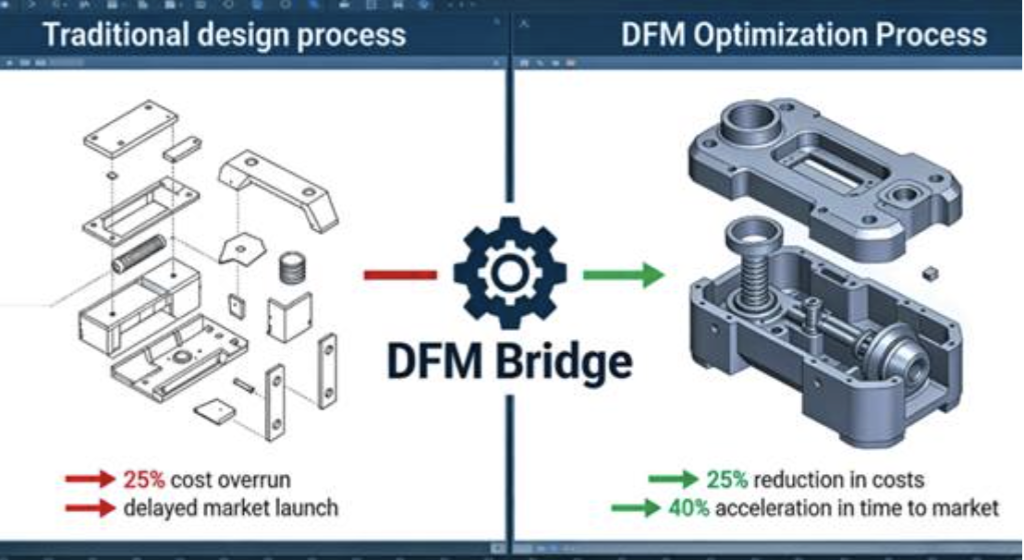
In the environment of competitive product development, there is one major limiting factor that impacts project success, that is, cost overrun and long lead time. Many projects fail because of an inherent mismatch between design requirements and manufacturing realities, hence prototype loops. The main reason always originates in conventional design practices where design ignores manufacturing realities because of an emphasis on shape, appearance, or functionality.
In this article, we will examine just how Design for Manufacturing (DFM), a design methodology, incorporates manufacturing requirements early on during design to produce cost-efficient designs for rapid market entry. Starting with standards and case studies, this article will continue to break down just exactly what Design for Manufacturing is all about.
What Is Design for Manufacturing (DFM) and How Does It Reduce Risks in the Production Phase?
Design for Manufacturing (DFM) is a method of designing with manufacturing processes taken into consideration from inception. The key objective of this strategy is to ensure that parts are simplified to guarantee cost-effective manufacturing without any compromise on quality. The strategy also guards against any manufacturing risks by dealing with any potential manufacturing challenges from inception. In that way, Design for Manufacturing becomes a risk-cure strategy.
1. The Core Philosophy: Proactivity Rather than Reactivity
Design for manufacturing is quite a departure from the classical sequential method of engineering. These designs have typically been “thrown over the wall” from design engineers to manufacturing teams. DFM, however, is a methodology that encourages a collaborative and iterative approach. The DFM way is a preventive method that translates a design for manufacturing, ensuring that it prevents problems from occurring. These values and ideas form a major part of industry best practices, including the Society of Manufacturing Engineers (SME) design for manufacturing guidelines. Designing versus manufacturing is a classic contrast that is triggered by DFM.
2. Quantifiable Risk Reduction
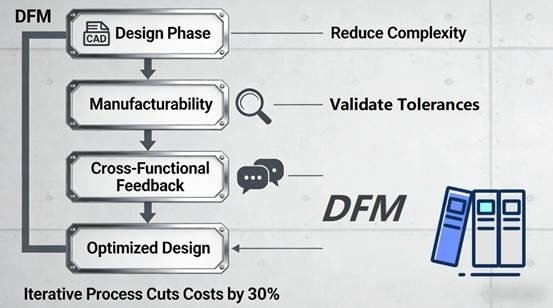
The impact of DFM can even be measured. Industry researches have discovered that integrating the principles of DFM will result in reducing production costs from 15% to 30%. This occurs due to effective utilization of material, reducing assembly time, keeping tooling simple, and avoiding defects. Designers can reduce surprises that come up during production if they analyze material characteristics, geometry of components, and tolerance analysis of parts during the very early design phases.
3. Alignment with Quality Management Systems
The principles of DFM are inherently supported by robust quality management systems. For example, an organization that is ISO 9001:2015 certified instills in itself a culture of preventive action, which aligns itself perfectly well with DFM’s objectives. Also, understanding context and risk, in accordance with this standard, instills a disciplined environment in an organization where DFM can flourish, making sure that quality is embedded in design, not inspected.
How Can DFM Guidelines Streamline the Product Development Process?
The DFM guideline provides a concrete framework for applying manufacturability principles, thus turning a theoretical approach into an operative workflow. In this respect, manufacturability guidelines smooth out the entire product development lifecycle, from concept to final production, and delineate rules and best practices.
l Simplification & Standardization: Reduction of complexity is a core tenet of DFM. Guidelines often recommend reducing the number of parts, using standard components, and designing for symmetric features to avoid orientation problems during assembly. Such a consolidation could be in the form of several components combined into one, and this can be accomplished with advanced processes like 5-axis CNC machining. Companies can reduce assembly times, for instance, by as much as 30% just by reducing the number of parts. This directly leads to speeding up production cycles and reducing labor costs.
l Optimizing for Specific Manufacturing Processes: More effective DFM guidelines exist for a given manufacturing process: whether it’s injection molding, computer numerical control machining, or sheet metal manufacturing. In particular, guidelines for machining would stress geometries that are easily accessible without tool changes and without deep, hard-to-reach areas. As discussed fully at sites such as the Design for Manufacturing (DFM) guide page, standardization of features throughout a range of related products could drastically improve productivity by making use of facilities already developed.
l Accelerating Design Validation: By adhering to established DFM guidelines, engineers can design their work so that it can easily be prototyped and validated. Designs that follow Manufacturability Optimization principles will have fewer changes when transitioning over to rapid prototyping. There is a seamless transition from digital to prototype that is very important to condense development cycles and bring products to market faster.
What Are the Key Principles of Cost-Driven Design in DFM?
DFM, essentially, revolves around cost optimization. The principles of cost-driven designs ensure that all decisions taken during the design process add to the economic feasibility of the product in terms of optimizing the total cost of ownership without compromising on performance.
1. Economical Tolerance Specification
One of the greatest expense multipliers when building something is the unnecessary use of close tolerance levels. The principles of DFM require that the maximum limits and spots for the highest possible level of tolerance, which will still ensure the function of the product, have to be established. Precision machining is a requirement, however, and a cost-effective design will assume that expending costs involving a tolerance of ±0.001 inches would be exponentially greater than that involving a tolerance of ±0.005 inches.
2. Material Utilization and Waste Reduction
DFM promotes the selection of materials based on material properties, but it also encourages selection based on costs and material processability, that is, material that is less expensive and easier to process. In addition, DFM entails designing for maximizing material utilization, that is, designing a part that can conveniently go into a standard sheet of material and a block of aluminum. Such designs will produce less scrap material, and the overall effect will reduce the material costs associated with raw materials.
3. Design for Assembly (DFA) Integration
DFM concentrates on product components, but its synergy with Design for Assembly (DFA) is critical when considering cost optimization. Consider design principles such as design simplicity of insertion, reduce fastening, and use self-location to decrease assembly time and skill and to avoid potential error issues. A DFM and DFA synergy ensures that costs saved during product component production are not incurred during assembly.
Why Is Cross-Functional Collaboration Critical for Successful DFM Implementation?
DFM cannot be implemented in a silo. Its effectiveness is completely dependent on overcoming functional barriers. Collaboration across functions will ensure blending of different knowledge from day one, leading to a holistic design with a market-ready product.
1. Breaking Down Information Silos
Working independently, design engineers might not have the critical perspective that is necessary for understanding the capabilities on the factory floor, the lead times from suppliers, and quality control issues. Cross-functional teams, which span the functions of both design and manufacture, as well as others, help ensure that all constraints and possibilities are understood from the outset, rather than having the “perfect” design proved impossible and/or unaffordable too late in the day when resources have already been committed.
2. Leveraging Digital Prototyping Software
The driving force behind today’s collaboration is the digital platform. The digital twin concept of common CAD systems enables various designers from different locations to work together by analyzing the same product at the same time. The digital thread in the process helps create a flowing dialogue in the Design forManufacturing process. For instance, in the auto sector, it has been observed that the iterations in designing can be reduced by 50% through this collaboration method.
3. Encouraging a Culture of Continuous Feedback
Collaboration needs to be a continuous process and not a one-off exercise. Achieving a successful outcome in DFM requires a culture where the manufacturing feedback for existing products needs to be looped back into the design team for future designs. Such a closed-loop feedback process can help Production Experience translate into valuable knowledge through a Quality Management System to bring about continuous improvements in product designs.
The Role of Precise Manufacturing in Improving DFM Results for Rapid Prototyping
Precision manufacturing techniques are the enablers that make designs that are optimal for DFM a reality in medical device prototyping. The marriage between medical device design best practices for DFM and precision manufacturing capabilities spells a new synergy in medical device prototyping, in that the prototype is an exact replica of the finished medical device.
1. Bridging Digital-Physical Divide: One of the most important tasks involved in prototyping is making sure that the manufactured prototype aligns with its design on a digital platform. Precision manufacturing, including high-end CNC machining services, is very effective in this respect. Such manufacturing is capable of creating a prototype through production-quality material, thus allowing functionality tests to take place on a prototype that helps verify a design optimized for DFM or design for manufacturing.
2. Enabling Complex, Consolidated Designs: DFM prototypes tend to be complex, lightweight, and fully consolidated. These prototypes may contain features that are impractical to produce using conventional manufacturing techniques. 5-Axis CNC machines possess the ability to produce complex features in one setup, making them ideal for use in manufacturing prototypes derived from DFM principles, without compromising on the principles of the original design. Engineers using this technology can come up with innovative designs.
3. Accelerating Iterative Cycle: Rapid prototyping cycle time is also very important. If a design error is spotted during a test process, a quick turn-around is required. Precision manufacturing tools are often implemented through an automated process that can manufacture a new prototype for a product in a matter of days. Hand-in-hand implementation with a strong DFM will result in a 40% cut-back on overall time required for a product to reach the marketplace.
What Are the Benefits of Outsourcing DFM Analysis to Specialized Service Providers?
In many cases, especially in SMEs, it would not be feasible to develop in-house expertise in DFM. Contracting an independent provider for analysis in this regard creates an opportunity, which includes expertise along with latest technological advancements, without their cost burden.
1. Specialized Knowledge & Technology Access
The service providers for DFM are well versed in a variety of industries and projects, thus benefiting from this knowledge. They are also likely to invest in advanced simulation tools and advanced manufacturing equipment. When a company partners with this expert service provider, it benefits from their knowledge of optimizing areas that might be unknown by their own internal teams. The service provider helps ensure that their design is fully optimized for cost, performance, as well as manufacturing.
2. Improved Credibility & Compliance
Working with a partner who has relevant credentials increases an element of confidence and ease of entry to the market, particularly in regulated fields. A partner certified for adherence to ISO 9001, AS9100D in aerospace, or ISO 14001 in relation to environmental issues shows commitment to strict process adherence and environmental sustainability. The overall assurance these credentials create for customers is that their projects will be dealt with to an utmost level of professionalism.
3. Emphasis on Core Competencies & Cost-Savings
Outsourcing DFM analysis enables the internal engineering department of a company to devote time to its core competencies like innovation and product functionality. In other words, it helps to improve efficiency. Secondly, it is a more cost-effective method because the fee for an expert’s service will be cheaper compared to the total costs involved when working with a team of employees that have the same expertise.
Conclusion
Design for Manufacturing is not an end design checklist but an essential design strategy in the field of product development. Design for Manufacturing not does not focus on tackling the symptoms but the actual causes of increased project costs and project delays in the product development field. It allows product development engineers to design innovative, efficient, and reliable designs of products that result in fast time-to-market with superior product quality. This harmonious blend of Design for Manufacturing, cross-functional collaboration, and precision manufacturing becomes the strong foundation for ensuring fast time-to-market with superior product quality in this era of stiff competition.
FAQs
Q1: What is Design for Manufacturing (DFM) ?
A: Design for Manufacturing (DFM) is a proactive design process that incorporates manufacturing limitations in the early design stage. DFM aims at part simplification, material selection, and optimal tolerance allocation. The method ensures that designs go into production easily and at a cost that is, on average, 15-30% lower.
Q2: How does DFM reduce costs?
A: DFM reduces costs because it eliminates costly features of production and encourages standardization and use of materials. Specifically, DFM directly reduces waste, processing time, and design corrections. For instance, manufacturability can reduce costs of material by as much as 20%.
Q3: What are the important activities in the DFM process?
A: The typical steps would include a preliminary design review, a detailed manufacturability assessment, and prototyping and optimization. These require a significant interface between design and manufacturing organizations in order to assess manufacturability and align design requirements within manufacturing capabilities.
Q4: What is the importance of inter-function collaboration in DFM?
A: Cross-functional collaboration involves integrating expertise in areas such as engineering, manufacturing, or supply chain in the initial stages of project development. This eliminates project delay costs, reducing project delay costs by 50% in project timelines.
Q5: How can companies begin with DFM services?
A: companies can start by contacting a qualified supplier for a free DFM analysis of their designs. It gives companies access to expert knowledge that can be used for improved designs without much investment in-house.
Author Bio
The writer has expertise in precision manufacturing at LS Manufacturing, assisting engineers or researchers in handling complicated components for his company, which deals in aerospace, medical, or automotive components. The writer has certification in IATF 16949, AS9100D, ISO 9001, offering excellent services to their customers, emphasizing design-manufacturing tenets. In order to fetch more information, Click Contact Them Today for Free Project Review & DFM Analysis. Turn Your Thought into Reality with an affordably feasible Solution.