



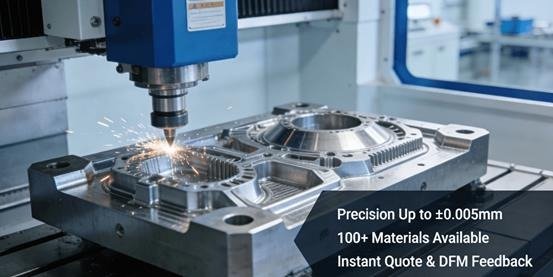
In the precision manufacturing sector, CNC milling of complex metal parts often faces challenges of budget overruns and delivery delays, particularly in high-demand industries such as aerospace and medical devices. The core issue lies in traditional approaches that focus on cost reduction in isolated segments, neglecting systemic optimization from design origins, process parameters, and supply chain management.
The article discusses an integrated approach for cost control in the areas of design, materials, processes, and suppliers. The next sections will analyze each critical component in depth.
Laying the Foundation for the Cost Optimization of CNC Milling from the Design Stage
The design stage represents the core step in cost control, in which Design for Manufacturability (DFM) becomes an important consideration. Use of simplified geometric shapes, fillet radius standardization with values no smaller than 0.5mm for internal corners, or avoidance of deep holes or thin slots can help to make machining easier, reducing machining time. Thus, for example, complex internal geometries might necessitate custom machining tools or require multiple machining setups, whereas improved designs result in machining using standard tools in reduced machining setups, thus making programming easier.
Early adoption of rapid prototyping solutions for prototype validation helps avoid expensive design changes during mass production. This proactive approach in precision engineering services ensures that CNC milling parts are inherently efficient and cost-effective right from the start. According to the American Society of Mechanical Engineers (ASME) , the manufacturing cost is basically dictated by design decisions.
How Do Material Selection and Processing Parameters Implicitly Affect Total Cost?
Cost Effects of Material Selection
Material selection extends beyond raw material prices, directly impacting machinability, tool wear, and post-processing expenses. In metal CNC milling, aluminum offers high efficiency and low tool wear, whereas stainless steel and titanium alloys, despite higher material costs, increase processing time and tool consumption due to their strength and hardness. For applications requiring finishes like mirror polishing, material properties are crucial. For example, 316L stainless steel, with its superior corrosion resistance and stable microstructure, is more reliable for achieving Ra≤0.1μm surface quality in Stainless Steel CNC Mirror Polishing compared to 304 stainless steel, avoiding polishing failures and reducing lifecycle costs.
Optimization Strategies for Processing Parameters
After basic speed and feed rate modifications, advanced techniques include real-time monitoring and adaptive control. For example, by incorporating sensors that measure the tool wear and thermal drift process during metal CNC milling, machining parameters can be optimized real-time. Such an optimized process not only minimizes manual intervention, apart from increasing cost efficiency for On Demand Production batches, it also guarantees a high degree of precision.
l High-Efficiency Milling Parameters
Cost optimization hinges on “high-efficiency milling” achieved by optimizing cutting speed, feed rate, and depth of cut. Leveraging industry databases, such as those from the Society of Manufacturing Engineers (SME) , enables maximized material removal rates while maintaining precision, directly reducing machine hours, which constitute a major portion of CNC Milling Cost.
l Flexibility for Small-Batch Production
The On-Demand Production model requires quick response times. Parametric programming and modular fixtures make it possible to switch easily from one product to another and enable small-batch, economically feasible production despite fixed costs.
How Does High Precision CNC Milling Accomplish Zero Defect Cost Reduction?
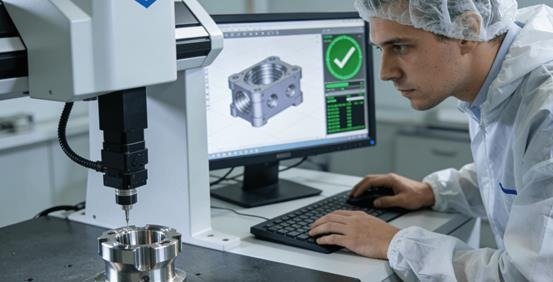
Investment in high-technology manufacturing machinery is fundamental to future cost savings. High Precision CNC Milling involves the use of machining equipment such as 5-axis machines. These types of machines eliminate setting up time with one time machining. In-process measurement capability provides the ability to monitor continuously. As a result, it is possible to produce products with the first time right objective to minimize scrap. Suppliers with strict process controls are companies that provide assurance of successful process control. Examples of such companies are JS Precision with aerospace certification of AS9100D.
The table below summarizes key process control elements:
| Process Control Element | Control Method | Contribution to Cost Savings |
| First-Article Inspection | Full-dimension verification using CMM | Prevents batch dimensional deviations, avoiding rework/scrap |
| Statistical Process Control (SPC) | Real-time data collection and analysis of key dimensions | Predicts process drift, enabling adjustments before defects occur |
| Environmental Control | Workshop temperature maintained at ±1°C | Prevents thermal deformation, ensuring consistency |
Such CNC Machining Services emphasize quality assurance to minimize hidden expenses.
How Do Online Platforms Simplify the Procurement and Cost Control of CNC Milling Parts?
Digital procurement platforms have fundamentally transformed the traditional approach to sourcing CNC milling parts online. By integrating instant quotation engines, these systems allow engineers to upload a 3D model and receive accurate pricing and automated Design for Manufacturability (DFM) analysis within minutes, a process that traditionally took days. This immediacy front-loads cost discussions and enables rapid design iterations, significantly accelerating development cycles.
These platforms enhance transparency and efficiency throughout the procurement process. Customers benefit from real-time production updates and digital order tracking, providing clear visibility into project status from quote to delivery. This streamlined approach stands in stark contrast to traditional methods reliant on repetitive emails and phone calls, which often lead to communication delays and opaque pricing.
The model makes Custom Part Manufacturing highly accessible. The digital process reduces administrative overhead and eliminates intermediaries, often resulting in significant cost savings. By handling supplier vetting, order management, and quality control, online platforms allow engineers to focus their efforts on core design and R&D rather than logistical challenges.
What Core Indicators Should Be Considered When Choosing a Custom Stainless Steel Parts Manufacturer?
Selecting a Custom stainless steel parts manufacturer necessitates a multi-faceted evaluation that extends far beyond initial pricing.
Technical and Quality Hard Power
Technical capability is the number one consideration. A manufacturer’s equipment list, featuring advanced machinery including 5-axis mills and specialized polishing systems, directly dictates its ability to handle complex geometries. Precision certifications, such as the ability to hold ±0.002mm positioning accuracy, are non-negotiable for high-tolerance work. While foundational quality systems like ISO 9001 are expected, industry-specific certifications-e.g., IATF 16949 for automotive-offer critical assurance of compliance with rigorous sector-specific standards.
l Equipment and Certification
Advanced machining and inspection equipment are the bedrock of precision, while authoritative certifications offer validated proof of a robust quality management system.
l Industry Experience and Cases
A proven track record, demonstrated through successful case studies in similar Custom Part Manufacturing, is a strong predictor of a supplier’s capability to overcome specific challenges like achieving a flawless complex surface polish.
Engineering Support and Collaboration Capabilities
A quality manufacturer offers complete support with engineering. Collaborating in such a manner, from materials selection guidance and forward Design for Manufacturability (DFM) review, is extremely beneficial with regard to avoiding costly obstacles, and Total Cost of Ownership (TCO) optimization. By aligning with a precision CNC milling specialist, long-term integrity and value is assured that easily exceeds any fraction of cost considerations.
Conclusion
In a nutshell, cost optimization for precision CNC milling is systemic in design, processes, management, and supplier selection, rather than isolated price negotiations. A holistic approach provides true efficiency and savings.Immediately contact certified precision manufacturing experts to obtain a detailed quote with DFM analysis and cost-optimization suggestions for your next project.
Author Biography
The author is a senior consultant in precision manufacturing with over 15 years of industry experience, specializing in helping manufacturing enterprises optimize supply chains and reduce production costs.
FAQs
Q: How to control costs for small-batch complex CNC milling parts?
A: Using modular fixtures, optimized cutting parameters, and suppliers supporting small batches effectively distributes fixed costs for economical production.
Q: What are the main cost drivers for stainless steel mirror polishing?
A: Key factors include initial surface quality (Ra value), geometric complexity, and tolerance requirements. Complex curves and ultra-low roughness (e.g., Ra<0.1μm) increase manual polishing time and cost.
Q: How to verify a CNC milling supplier’s precision commitments?
A: Request first-article inspection reports (FAIR) with CMM data and verify certifications like ISO 17025 or equivalent quality credentials.
Q: How does material selection differ between rapid prototyping and final production?
A: Prototypes may use easy-to-machine materials for functional validation; mass production must balance mechanical properties, durability, and cost for optimal material choice.
Q: Beyond price, what potential costs should be considered in procurement?
A: Hidden costs include rework/scrap from quality issues, project disruptions from delays, and management costs from poor communication.