


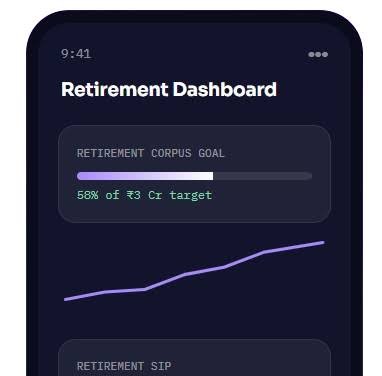
Planning for retirement is one of the most critical long-term financial exercises an individual undertakes. With rising life expectancies, changing lifestyle requirements, and the gradual reduction of traditional defined-benefit pension structures, accumulating an independent retirement fund has become essential.
Because retirement planning spans several decades—encompassing both the accumulation phase during working years and the distribution phase after retirement—estimating the target corpus accurately requires an understanding of inflation, compounding, and disciplined investing. Using a Systematic Investment Plan to invest in a Mutual fund portfolio provides a structured, automated mechanism to build this corpus steadily over time.
1. What Is a Retirement Corpus?
A retirement corpus refers to the total accumulated pool of savings and investments needed to generate regular cash flows after active employment ceases. The primary objective of this fund is to sustain living standards, manage healthcare expenses, and protect against purchasing power erosion caused by price inflation throughout the post-retirement years.
Estimating this amount requires looking beyond nominal figures. An annual expenditure that feels sufficient today will typically cost significantly more two or three decades later due to compounded inflation.
2. Key Components Required to Calculate the Corpus
To estimate the total capital needed at retirement, several fundamental parameters must be evaluated systematically:Current Living Expenses and Non-Discretionary Spending
The estimation starts with an audit of current household expenditure. This includes essential costs such as housing, utility bills, groceries, insurance premiums, and healthcare, alongside discretionary lifestyle expenses. Certain costs—such as work-related commuting or child education—may drop post-retirement, while healthcare expenses and leisure allocations may increase.Expected Rate of Inflation
Inflation steadily diminishes the purchasing power of money over time. For example, at an average long-term inflation rate of 6% annually, living expenses can double in approximately twelve years. Therefore, all future expense projections must account for compounded inflation between the current age and retirement age, as well as inflation during retirement itself.Time Horizons (Accumulation vs. Distribution)
- Accumulation Phase: The number of earning years remaining before retirement. A longer timeframe allows for greater compounding and a higher capacity to withstand market cycles.
- Distribution Phase (Post-Retirement Horizon): The expected number of years the corpus will need to supply income, generally calculated from the age of retirement to an assumed life expectancy (commonly 80 to 85 years or more).
Expected Post-Retirement Rate of Return
Once an individual retires, the corpus is typically reallocated toward more conservative, income-generating instruments. The assumed rate of return on the retirement fund during the withdrawal phase is usually lower than during the accumulation phase to reflect this shift toward capital preservation.
3. The Step-by-Step Estimation Framework
Estimating the corpus involves a step-by-step mathematical progression:
- Calculate Future Annual Expenses at Retirement:
Adjust current annual expenses using expected inflation over the remaining working years:
FutureExpense=CurrentAnnualExpense(1+r)n
(where r is the inflation rate and n is the number of years to retirement).
- Determine the Real Rate of Return Post-Retirement:
The real return is the net portfolio return after adjusting for inflation during retirement:
RealRate=1+InvestmentReturn1+Inflation-1
A positive real return ensures the purchasing power of the corpus remains relatively stable. - Calculate the Final Target Corpus:
Using the future annual expense and the post-retirement horizon, calculate the present value of an annuity growing with inflation. This total figure represents the target retirement corpus required on the day of retirement.
4. Accumulating the Corpus Through Monthly SIP Investments
Once the target retirement corpus is established, the next task is determining how much to save and invest each month.
A Systematic Investment Plan allows an individual to commit a predetermined amount on a set date each month into selected funds. This structure offers several operational advantages:
- Automated Fiscal Discipline: Deductions occur automatically, reducing the risk of discretionary overspending.
- Rupee Cost Averaging: Investing fixed amounts across market fluctuations naturally purchases more units when markets decline and fewer units when markets rise, helping moderate average acquisition costs over time.
- Compounding Benefits: Reinvesting earnings over long horizons allows returns to generate their own returns, significantly reducing the actual out-of-pocket capital needed compared to the eventual corpus size.
To determine the exact monthly contribution needed to bridge the gap between zero (or existing savings) and the estimated target corpus, investors frequently utilize a SIP calculator. By inputting the target maturity amount, the investment tenure in years, and an assumed rate of return, the calculator computes the necessary monthly commitment.
5. The Role of Step-Up SIPs
A flat monthly investment over 20 or 30 years may not keep pace with career earnings or changing financial obligations. As professional income increases over time, investors often implement a “Step-Up SIP” (or top-up facility).
Increasing the monthly investment amount by a modest fixed percentage annually—such as 5% or 10%—can significantly reduce the initial monthly burden. This aligns contributions with natural salary increments and helps absorb the impact of inflation without straining early-career cash flows.
6. Portfolio Allocation and Risk Management Over Time
Retirement accumulation is an evolving process that requires adjustments across life stages:
| Phase | Horizon | Focus | Typical Allocation |
| Early Career | 20+ years to retirement | Capital appreciation | Higher allocation to equity-oriented funds to outpace long-term inflation. |
| Mid Career | 10–20 years to retirement | Balanced growth | Moderate equity exposure combined with fixed-income and hybrid debt schemes. |
| Pre-Retirement | Less than 5 years to retirement | Capital preservation | Systematic transition from volatile assets into conservative debt and liquid instruments. |
Conducting periodic portfolio audits ensures that the investment trajectory remains aligned with initial assumptions. If market returns diverge or personal goals change, regular reviews allow for measured adjustments to monthly contributions rather than reactive portfolio shifts.
Conclusion
Estimating a retirement corpus requires an objective assessment of future expenditures, anticipated inflation, and life expectancy. Rather than relying on approximate figures, working through structured calculations provides clarity on long-term capital requirements. Committing to a systematic monthly investment plan enables individuals to build this capital progressively, taking advantage of compounding and rupee cost averaging to pursue post-retirement financial independence.