

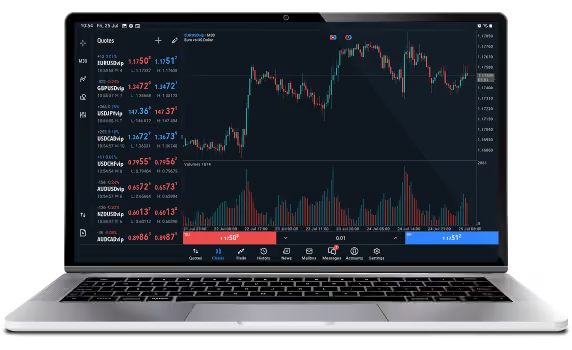
Modern financial markets require traders to work with large amounts of information while making decisions within changing market conditions. A powerful trading environment can bring market observation, chart analysis, technical tools, order management, and account information into one organized workspace. For users exploring the MT5 Trading Platform, its range of features can support a structured approach to analyzing global markets and managing trading activity.
A Comprehensive Trading Environment
A modern trading platform is designed to give traders access to important market information without creating an unnecessarily complicated workflow. A centralized workspace can allow users to monitor instruments, review price movements, study charts, and manage positions from a single environment.
Global markets can behave differently depending on economic conditions, trading sessions, liquidity, and investor sentiment. Having a flexible workspace can make it easier for traders to follow the markets that are relevant to their individual strategies.
The purpose of a trading platform is not to make decisions automatically for every user. Instead, it provides tools that can help traders collect information, analyze market behavior, and execute decisions according to their own plans.
Global Market Access
Access to multiple financial markets can provide traders with broader opportunities for analysis. Depending on available instruments, users may be able to study currency markets, commodities, indices, digital assets, and other financial instruments within one trading environment.
Following several markets can help traders develop a wider understanding of price behavior. For example, changes in one market may occur alongside movements in another because of changing economic expectations, market sentiment, or demand conditions.
However, broader access also requires greater discipline. Traders do not necessarily need to follow every available instrument. Selecting a manageable group of markets can help users concentrate their research and avoid unnecessary information overload.
Advanced Charting Capabilities
Charts form an important part of technical market analysis. They provide a visual representation of historical price activity and allow traders to study how instruments have behaved over different periods.
Multiple timeframes can help create different perspectives. Short-term charts may be useful for examining recent movements, while longer timeframes can help traders understand broader market trends.
A flexible charting environment can also allow traders to apply drawing tools and visual references. Trend lines, horizontal levels, channels, and other chart elements can help organize observations and highlight areas that deserve closer attention.
Chart customization can also make the workspace more comfortable. Traders can select layouts and views that match their preferred methods of analysis.
Technical Analysis Tools
Technical analysis uses price information and mathematical calculations to examine possible trends, momentum, volatility, and market behavior. A powerful platform can provide a variety of indicators that traders may use as part of their analytical process.
Different strategies require different analytical approaches. Some traders may concentrate on trend direction, while others may study momentum or potential changes in volatility. The flexibility to combine price charts with selected indicators can make analysis more detailed.
At the same time, indicators should be used carefully. No technical tool can remove uncertainty from financial markets. A signal that appears useful in one market environment may behave differently when conditions change.
Keeping analysis focused is often more practical than filling a chart with numerous indicators. Traders can select tools that directly support their strategy and understand how those tools behave before relying on them.
Market Monitoring and Watchlists
Efficient market monitoring is another important aspect of a trading environment. Traders may need to follow price changes across several instruments while identifying markets that deserve additional analysis.
Watchlists can help organize this process. Instead of searching for instruments repeatedly, users can maintain a selected list based on their interests and trading plans.
A well-organized watchlist can also support a regular trading routine. Traders can review selected markets at specific times, identify notable movements, and decide which instruments require deeper analysis.
Monitoring does not necessarily mean acting on every price movement. In many situations, observing market behavior without immediately entering a position can be an important part of disciplined trading.
Order Management
Trading activity involves more than identifying potential opportunities. Traders also need reliable methods for managing orders and positions.
An organized platform can help users open positions, review active trades, modify orders, and close positions according to their plans. Understanding these functions is particularly important when markets are moving quickly.
Before placing an order, traders should consider the intended entry point, possible exit conditions, position size, and acceptable level of risk. Having these details established beforehand can reduce impulsive decisions.
Order management should remain connected to the overall trading strategy. A platform provides execution and management tools, but the responsibility for deciding how those tools are used remains with the trader.
Risk Management and Position Control
Risk management is one of the most important elements of financial market participation. Even detailed analysis cannot guarantee that a trade will move in the expected direction.
Traders should consider how much capital they are willing to expose to individual positions and how multiple positions may affect overall exposure. Position size, leverage, margin requirements, and potential market volatility can all influence risk.
Leverage deserves particular attention because it can increase the size of market exposure relative to the capital committed. While leverage can make smaller price movements more significant, it can also increase losses.
Establishing risk limits before entering a trade can provide a more disciplined framework. Traders may also review their completed positions to understand whether their decisions followed their original plan.
Multiple Timeframes for Better Perspective
Studying more than one timeframe can help traders avoid focusing too narrowly on short-term price movements. A market may appear to be moving in one direction over a short period while displaying a different structure over a longer timeframe.
For this reason, traders may compare shorter and longer charts before making decisions. A broader timeframe can provide context, while a shorter timeframe can help examine more recent activity.
The usefulness of multiple timeframes depends on the individual’s strategy. Traders should develop a consistent process rather than changing timeframes randomly whenever market conditions become uncertain.
Flexible Workspace and Customization
A powerful trading environment can become more useful when traders are able to organize it according to their preferences. Different users may require different combinations of charts, market information, indicators, and order-management features.
Customization can make frequently used information easier to locate. A clean workspace may also reduce distractions and help traders maintain a consistent analytical routine.
Traders who follow several instruments can create separate layouts for different market groups or strategies. Keeping these arrangements organized can make it easier to move between different analytical tasks.
Trading Across Different Market Conditions
Financial markets are not static. Prices can respond to economic developments, changing expectations, market sentiment, liquidity conditions, and unexpected events.
A flexible platform can help traders adjust their analysis as conditions change. During active periods, users may pay closer attention to price movement and volatility. During quieter periods, they may focus more on broader trends and preparation.
Successful use of trading technology requires adaptability. A strategy that works well under one set of market conditions may require adjustments when volatility or liquidity changes.
Developing a Consistent Trading Routine
Technology becomes more effective when combined with a structured routine. Traders can begin by reviewing relevant markets, checking selected instruments, studying charts, and identifying important price levels.
After analysis, traders can compare potential opportunities with their risk limits and trading objectives. If conditions do not match the planned criteria, remaining outside the market may be preferable to forcing a trade.
Keeping records of trading decisions can also support improvement. Reviewing previous positions may reveal patterns in decision-making, including repeated errors or situations where the original plan was followed successfully.
Consistency does not mean that every trade will produce the desired result. Instead, it means following a defined process even when individual outcomes vary.
The Role of Technology in Modern Trading
Trading technology has changed how market information can be accessed and organized. A modern platform can provide charts, indicators, market monitoring, and trading functions within an integrated environment.
However, technology should be considered a tool rather than a substitute for knowledge. Traders still need to understand the markets they follow, recognize the risks involved, and develop realistic expectations.
Learning how each feature works can also improve confidence. Traders can practice using analytical tools, explore chart functions, and become familiar with order management before relying heavily on them during active market conditions.
Security and Account Awareness
Responsible trading also involves maintaining awareness of account information and trading activity. Users should understand their account settings, available funds, margin information, and current exposure.
Regularly reviewing account activity can help traders identify whether positions and orders remain consistent with their plans. Maintaining organized records can also make performance evaluation easier.
Account awareness should be treated as part of the overall trading routine rather than something that is checked only after a trade has been completed.
Conclusion
The MT5 Trading Platform offers a powerful environment for traders seeking organized access to global financial markets. Its combination of charting capabilities, technical analysis tools, market monitoring, order management, multiple timeframes, and workspace flexibility can support different trading approaches.
Access to professional trading features does not eliminate market uncertainty or guarantee positive results. Traders must still evaluate conditions carefully, control their exposure, and understand the risks associated with financial market activity.
When used thoughtfully, a flexible trading environment can help transform large amounts of market information into a more organized analytical process. By combining appropriate tools with preparation, discipline, risk management, and continuous learning, traders can build a structured approach to exploring global markets and managing their trading decisions.