

If you are looking at the stock market today in India, you are entering one of the world’s most dynamic equity markets, one that is regulated, electronic, and increasingly accessible. For first-time investors, understanding a few core concepts can turn confusion into confidence.
What Is the Stock Market?
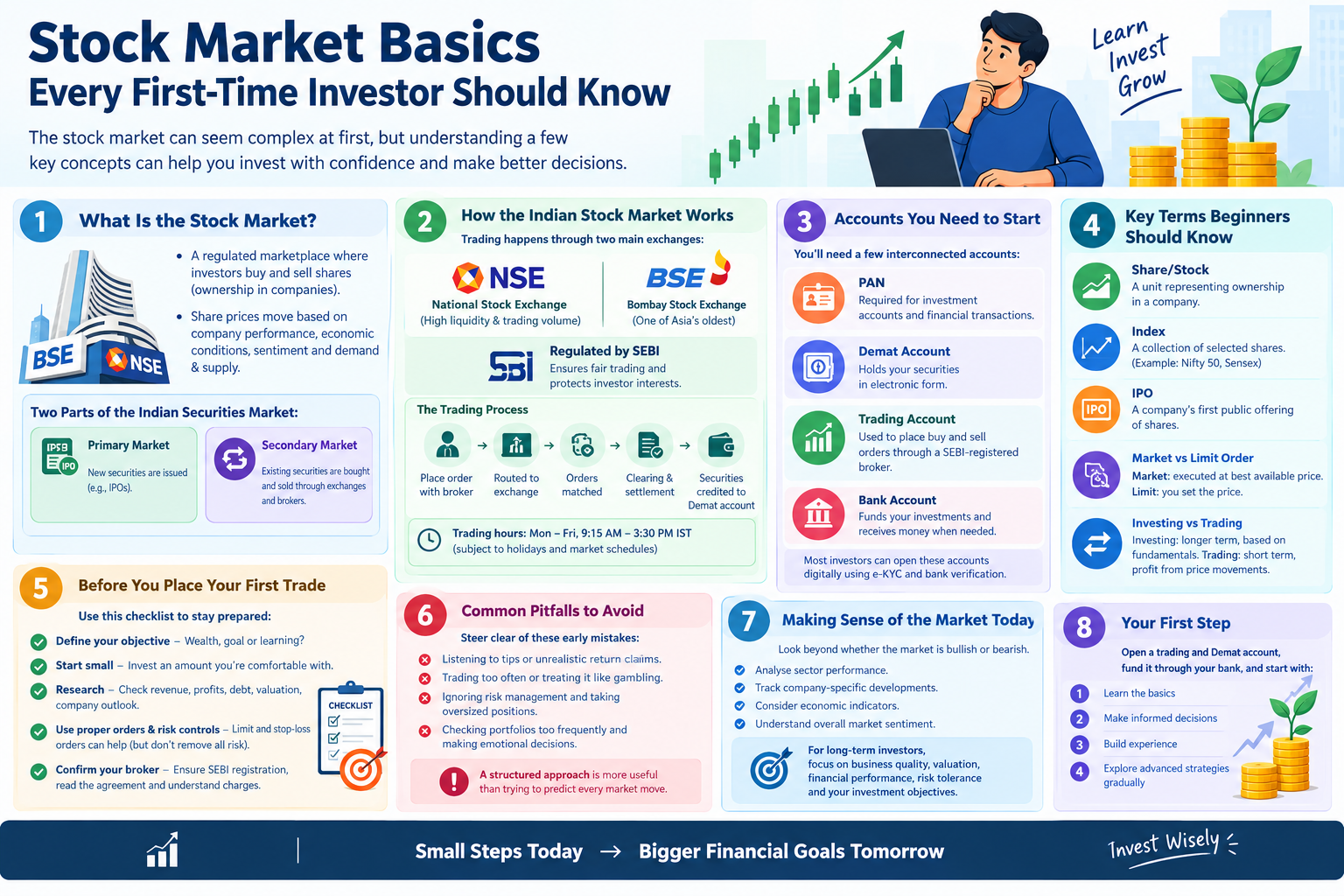
The stock market is a regulated marketplace where investors buy and sell shares, which represent ownership in listed companies. When you buy shares, you own a small part of the company, and the value of your investment can change depending on the company’s performance, economic conditions, investor sentiment, and the demand and supply for its shares.
In India, the securities market can broadly be classified into two categories:
Primary market: This is the market where new securities are issued, such as through an IPO.
Secondary market: This is where existing securities are bought and sold through recognised stock exchanges and registered brokers.
How the Indian Stock Market Works
In India, stock trading is carried out mainly through two stock exchanges:
NSE (National Stock Exchange): One of India’s leading stock exchanges, known for its high trading volumes and liquidity.
BSE (Bombay Stock Exchange): One of the oldest stock exchanges in Asia, with a large number of listed companies.
Both exchanges operate under the regulatory framework of SEBI (Securities and Exchange Board of India), which is responsible for regulating the securities market and protecting investor interests.
The buying and selling process generally works as follows:
-You place an order through a SEBI-registered broker.
-The order is electronically routed to the relevant stock exchange.
-The stock exchange matches compatible buy and sell orders.
-The trade then goes through the clearing and settlement process, after which the purchased securities are credited to your Demat account.
-The regular equity market trading session in India is generally from Monday to Friday, 9:15 AM to 3:30 PM IST, subject to exchange holidays and applicable market schedules.
Accounts You Need to Start
When it comes to investing in the Indian stock market, you will need a few interconnected components:
-PAN: Required for opening investment accounts and carrying out various financial transactions.
-Demat account: Holds your securities in electronic form.
-Trading account: Used to place buy and sell orders through a SEBI-regulated broker.
You also need a bank account to fund your investments and receive funds when required. Most investors can complete the account-opening process digitally through e-KYC and bank verification.
Key Terms Beginners Should Know
-Share/Stock: A unit representing ownership in a company.
-Index: A collection of selected shares that represents a particular segment of the market. For example, the Nifty 50 and Sensex track major companies listed in India.
-IPO (Initial Public Offering): The process through which a company offers its shares to the public for the first time.
-Market vs limit order: A market order is placed for execution at the best available market price, subject to market conditions. A limit order allows you to specify the price at which you are willing to buy or sell.
-Investing vs trading: Investing generally involves holding securities for a longer period based on factors such as business fundamentals and financial goals, while trading usually involves buying and selling over shorter periods to benefit from price movements.
Before You Place Your First Trade
An easy-to-follow pre-investment checklist can help you avoid costly mistakes:
Define your objective: Are you trying to create long-term wealth, save for a specific financial goal, or learn about trading?
Start small and invest wisely: Begin with an amount you are comfortable investing rather than putting all your money into a single stock or asset.
Gather the required knowledge for your research: Understand factors such as the company’s revenue, profits, debt, valuation, and business outlook before investing.
Use appropriate order types and risk controls: Limit orders can help you specify an entry or exit price, while stop-loss orders can be used as part of a risk-management strategy. However, these orders do not eliminate the possibility of losses.
Confirm that you have a registered broker: Check whether your broker is registered with SEBI, read the client agreement carefully, and understand the charges and services offered.
Common Pitfalls to Avoid
It is common for investors at the beginning of their journey to make the following mistakes:
-Listening to tips or claims that promise unrealistic returns.
-Trading too often or treating the market like a form of gambling.
-Ignoring risk management by taking excessively large positions or failing to understand potential losses.
-Checking portfolios too frequently and making emotional decisions based on short-term market movements.
-Learning to take a structured approach can be more useful than trying to predict every market move.
Making Sense of the Market Today
When analysing the Indian stock market today, consider more than just whether the overall market is bullish or bearish. Investors should also look at sector performance, company-specific developments, economic indicators, and broader market sentiment.
For long-term investors, factors such as business quality, valuation, financial performance, risk tolerance, and investment objectives are generally more important than short-term market fluctuations.
When you decide to invest in Indian stocks, the first step is to open a trading and Demat account and fund it through your linked bank account. Start by understanding the basics and making simple, informed investment decisions. As your knowledge and experience grow, you can gradually explore more advanced investment and trading strategies.