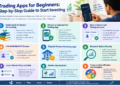



Investing in the stock market has become more accessible with the rise of digital platforms. Today, beginners can open investment accounts, research securities, place orders, and monitor portfolios through a smartphone. However, having access to a trading platform does not automatically make investing easier. New investors still need to understand how the process works and make informed decisions.
For those exploring trading apps for beginners, choosing the right platform is only the first step. Understanding how to use it responsibly is equally important. Here is a step-by-step guide to getting started.
Step 1: Understand the Basics of Investing
Understand the basics of the share market before downloading an app or making an investment. It is essential to understand terms such as shares, equity, market capitalisation, dividends, mutual funds, exchange-traded funds, and market indices.
It is equally important to know the distinction between investing and trading. Investing generally has a longer-term focus on wealth creation, while trading refers to buying and selling securities over shorter periods.
Understanding the fundamentals of risk, returns, diversification, and volatility can help novice investors make informed decisions.
Step 2: Choose an Appropriate Trading App
The chosen platform should meet the investor’s requirements, knowledge level, and financial goals. A trading app for beginners should offer straightforward usability and basic tools that do not make the investing process unnecessarily complicated. Beginners should prefer an application with straightforward usability and basic tools that do not make the investing process unnecessarily complicated.
Some important factors to consider are account security, order execution, market analysis tools, portfolio tracking, financial insights, educational resources, and transparent charges.
One should not concentrate only on the appearance or promotions while selecting a platform. It is better to focus on its efficiency, transparency, and dependability.
Step 3: Open a Demat and Trading Account
Investing in publicly traded stocks in India requires investors to have a Demat account along with a trading account. The Demat account is used to hold shares electronically, while the trading account is used to execute transactions.
Opening a Demat account is generally carried out through an online process involving the submission of identity proof, bank details, and other required information. Investors must check their details carefully and read the terms, fees, and disclosures as part of the registration process.
Step 4: Complete the KYC Process
Verifying your identity through Know Your Customer (KYC) is crucial for opening an investment account. Investors must provide details such as their PAN number, proof of identity, and current address, among other information, as required under applicable regulations.
Keeping these details updated can also help avoid hassles with future transactions or account-related services.
Step 5: Deposit Money into the Account
Once the account is operational, money can be transferred from a linked bank account. It is advisable for beginners not to invest funds that may be needed for essential short-term expenses.
It is wise to set aside an emergency fund before investing in any financial instrument.
Step 6: Research Before Buying
One of the most important things to learn as a new investor is to conduct research before placing trades. Financial results, business strategy, market position, valuation, and the outlook for the company are some of the factors that can play an important role in an investment decision.
It is also important to understand exactly what you are buying and identify the possible risks. Relying solely on social media advice, market trends, or short-term price movements may lead to rash decisions.
Step 7: Learn How to Place an Order
Trading apps can offer several types of orders. A market order is executed at the prevailing market price, subject to market conditions and liquidity. A limit order allows investors to specify the price they are willing to pay when buying or the minimum price they are willing to accept when selling.
Understanding the different order types is extremely important for beginners. Moreover, it is necessary to check the number of units, price, and transaction details before executing the order.
Step 8: Monitor the Portfolio
Investing is more than just buying an asset. Investors should review their investments regularly and ensure that they continue to serve their intended purpose.
However, constantly checking a portfolio may lead to emotional decisions, especially during volatile markets. A portfolio should be reviewed regularly based on the chosen investment strategy rather than reacting to daily price fluctuations.
Step 9: Focus on Diversification and Discipline
Investors who put most of their capital into a single asset may take on a significant amount of unnecessary risk. Diversifying investments across appropriate securities, sectors, or asset classes can help reduce portfolio risk.
Finally, novice investors should have specific investment goals and maintain discipline. The key to successful investing is regular investing and having a long-term approach rather than trying to predict the market’s next move every day.