

A few years ago, a rugged phone had one job: survive. If you also needed a thermal camera, a work light, a laser measure, or a projector, you carried each of them separately, along with their batteries and chargers. That bag of gear is getting smaller. Rugged devices now fold several of those tools into the same body that makes your calls and runs your maps.
This guide explains why the all-in-one rugged category is growing, which tools actually earn their place inside a phone or tablet, and where a single device still cannot replace dedicated equipment.
What Makes a Rugged Device “All-in-One”?
A rugged phone or tablet is the starting point: sealed against dust and water, reinforced against drops, and built with a larger battery than a consumer device. An all-in-one rugged device goes a step further by adding professional or field tools to that same housing, so one device handles communication, navigation, imaging, measuring, and sometimes presenting.
The idea is not new, but the execution has changed. Early attempts bolted on a basic feature and called it a day. Current devices integrate tools with real specifications, such as thermal sensors, autofocus projectors, and rangefinders with a stated working distance.
Why This Category Is Growing
Several shifts made the all-in-one approach practical. Components got smaller, so thermal sensors and projection engines now fit into a phone-sized body. Batteries got bigger, giving these devices more capacity to support demanding features such as projectors and high-powered cameras. And fast charging became common enough that a lunch break can restore a meaningful amount of runtime.
Demand moved in the same direction. Field crews, inspectors, and outdoor workers are tired of managing multiple batteries, chargers, and cases. Every extra tool is something to charge, pack, lose, or leave in the truck, so a device that covers several jobs reduces both weight and the chance of arriving on site without the right gear.
Which Built-In Tools Are Actually Useful?
Thermal Imaging
A thermal camera shows heat patterns that the eye cannot, which helps locate overloaded circuits, moisture behind walls, and heat loss in buildings. Built-in sensors are not a substitute for a dedicated inspection camera on high-stakes work, but they make quick scans possible whenever you happen to have the phone.
Projection
A built-in projector turns a wall into a shared screen for crew briefings, plan reviews, or training sessions. Phone and tablet projectors run in the low hundreds of lumens, so they work best in shaded or dim spaces at moderate distance.
Measuring and Night Vision
A laser rangefinder handles rough distance checks without a tape measure, and a night vision camera with infrared lighting supports documentation in dark crawlspaces or after-hours work. Both are best treated as convenient field tools rather than precision instruments.
Lighting and Power
A bright built-in light with warning modes can replace a small flashlight, and a very large battery reduces the need for a power bank on single-day jobs. Together they cover the two items most likely to run out at the worst moment.
Who Benefits Most From an All-in-One Device
The biggest gains go to people who use several of these tools in the same week. Electricians and building inspectors combine thermal scanning with photo documentation, site supervisors pair measuring with plan reviews, and outdoor crews rely on lighting, navigation, and long battery life together. For these users, one device that covers all of it simplifies packing and cuts the number of batteries to track.
Someone who only needs calls, maps, and the occasional drop protection gains far less. In that case, the extra tools add cost and weight without solving a daily problem.
Phone or Tablet: Two Shapes of the Same Idea
All-in-one rugged devices come in two main forms. A phone fits in a pocket or holster and stays with you all day, which suits work that keeps you moving. A tablet offers a larger screen for reading drawings, maps, and documents, and a bigger battery, but it is heavier and usually lives on a mount, strap, or vehicle.
Neither shape is better by default. The right choice depends on whether your day is spent walking and scanning or reviewing and presenting.
What All-in-One Devices Cannot Replace
The honest limits matter, because “does everything” can easily become “does everything adequately.”
Built-in thermal sensors and rangefinders are convenient but typically lower in resolution and range than dedicated professional tools, so they suit screening and quick checks rather than certified work. Projectors cannot compete with wall-powered units in bright rooms. Heavy use of the projector or camera drains the battery faster than normal use, and a single device means a single point of failure: if it breaks, you lose every tool at once.
Rugged ratings carry limits too. IP68 and IP69K describe protection against dust and water, not extreme temperatures or every drop, and seals wear over time. Check the recommended operating temperature range before relying on any device in very hot or cold conditions.
How to Judge an All-in-One Rugged Device Before You Buy
Follow these steps before deciding:
- List the tools you currently carry and how often you use each one.
- Check each built-in tool’s specifications, not just its name, including resolution, range, and lumens.
- Compare battery capacity and charging speed against your longest shift.
- Confirm the IP rating and the recommended operating temperature range.
- Decide whether a phone or tablet shape suits how you carry and use a device.
- Check the warranty and availability of replacement parts or service in your region.
Two All-in-One Rugged Devices
8849 TANK 5 Pro
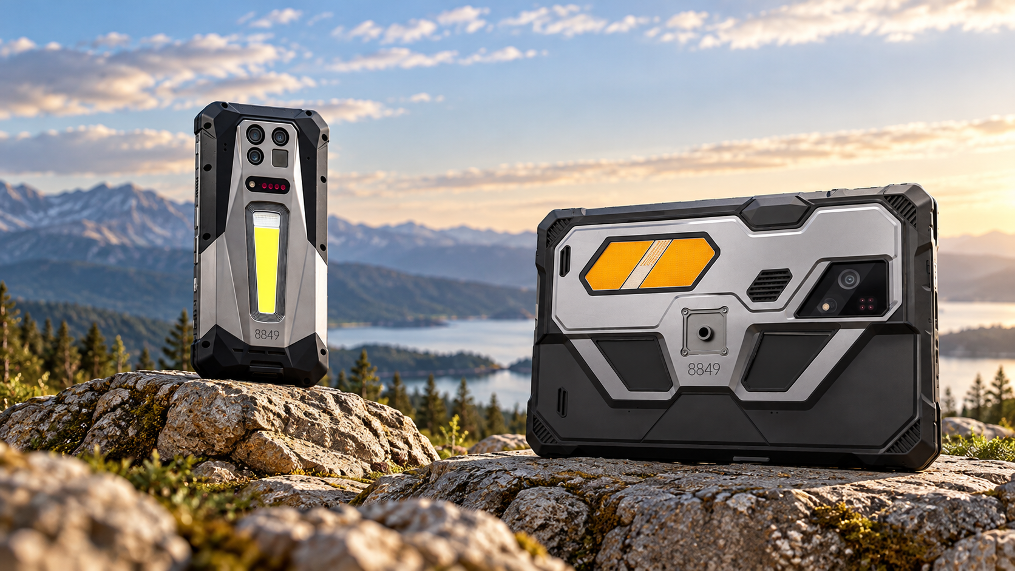
The TANK 5 Pro is an example of a rugged phone with a thermal camera, projector, rangefinder, and high-output light built into one device. It combines a 95° ultra-wide FLIR thermal camera with a 220-lumen 2K projector, a 1200-lumen light, and a laser rangefinder, all in an IP68/IP69K body. A 17,600mAh battery with 120W charging supports those tools, and a 6.73-inch 3K AMOLED display rated at 3000 nits keeps the screen readable outdoors. It can reduce the need to carry a separate thermal imager, pocket projector, and flashlight for many everyday field tasks.
8849 TANK Pad Ultra
The TANK Pad Ultra is the tablet-shaped example. It pairs a 10.95-inch 700-nit display with a 260-lumen 1080p projector, a 4-meter laser rangefinder, a 64MP night vision camera, and a 23,400mAh battery. It also adds dual-frequency GNSS and programmable push-to-talk keys. At 1,345g, it suits a mount, stand, or vehicle better than all-day carry, and 8849 recommends operating it between 0°C and 35°C.
Which One Should You Choose?
Choose a phone-shaped device like the TANK 5 Pro if your work keeps you moving, you need thermal imaging or quick measurements throughout the day, and you want everything in a pocket.
Choose a tablet-shaped device like the TANK Pad Ultra if your work is screen-heavy, involves reviewing maps or drawings, or benefits from briefing a group, and portability matters less than usable screen space.
Conclusion
All-in-one rugged devices are growing because the parts finally fit and the batteries finally last. Folding a thermal camera, projector, rangefinder, and light into one sealed body removes real friction for crews who used to manage a bag full of separate gear. The trade-off is that built-in tools favor convenience over specialist performance, and a single device means a single point of failure.
The smartest approach is to count the tools you actually use, check their specifications, and choose the shape that matches how you work. If a device replaces two or three things you carry every week, it earns its place. If it adds features you will never open, a simpler rugged phone or tablet is the better buy.