


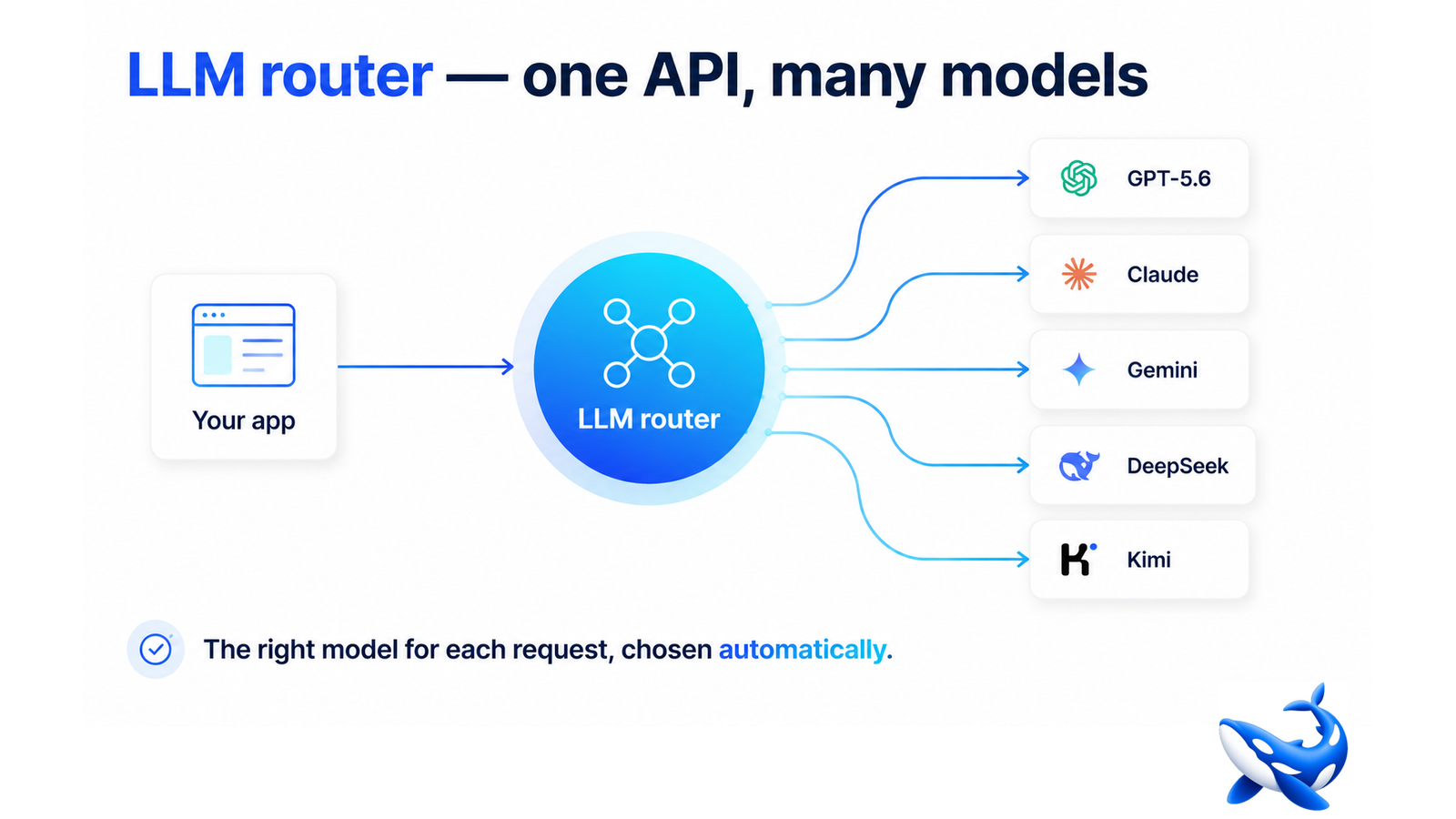
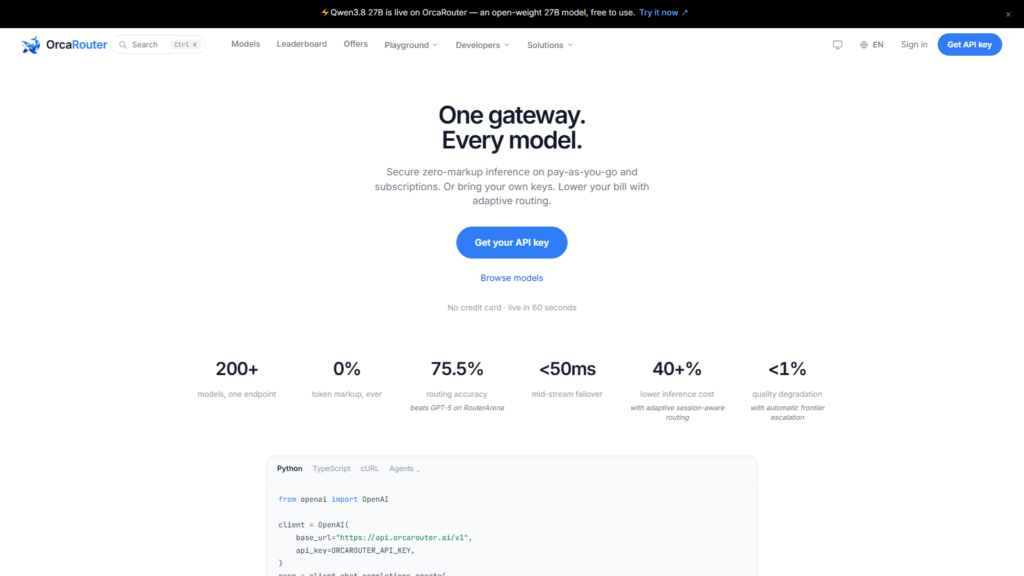
An LLM router is the layer that sits between your application and the language models it can call. Your code sends one request to one endpoint, and the router decides which model actually answers it — by cost, by latency, by capability, by current provider health. OrcaRouter is one platform built around this pattern, and the pattern is the important part: an LLM router is what lets a production system treat models as interchangeable rather than as commitments.
The problem it solves
Without a router, using more than one model means more than one integration. Each vendor brings its own client, its own key, its own rate limits, its own failure behaviour. The switching logic lives in your code, duplicated per service, and every model decision is hand-made per request. That is manageable at one model and painful at five.
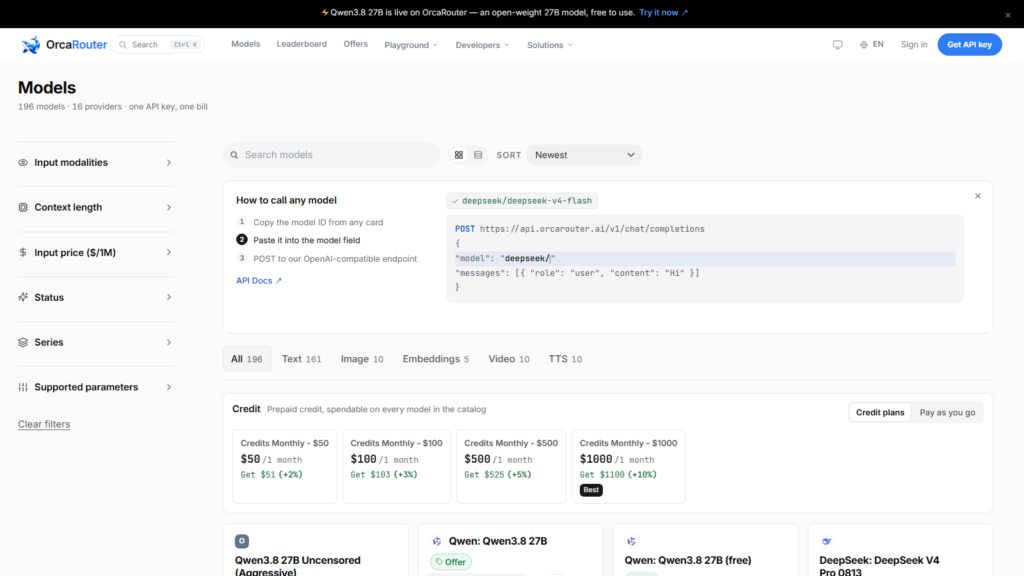
An LLM router collapses the integration and the decision into one place. The integration is a single OpenAI-compatible endpoint your existing client already speaks. The decision — which model for this request — is a routing rule the router applies automatically. Adding a model is a configuration change; switching a task type to a cheaper or better model is a rule change; failing over when a provider is down is the router’s job, not your error handling.
How the decision works
The router decides per request, against your rules and live conditions. The dimensions it weighs are the ones you would weigh by hand, if you had time: is the cheap model good enough for this task, is the fast model fast enough for this user, does this request need the frontier model, is the preferred provider healthy right now. The rules encode those judgements — cheap-first for tolerant work, strong-model for hard reasoning, failover to the healthy backup — and the router applies them consistently to every call from every service.
The practical difference
The difference between integrating a model and routing to a pool shows up in the daily work. When a vendor raises prices, the direct-integration team debates whether to migrate; the routed team demotes the model in the pool and traffic moves. When a new model ships, the direct team scopes an integration project; the routed team adds it and routes a percentage to measure it. When a provider goes down, the direct team pages someone; the routed team watches the failover. That asymmetry compounds — the routed team evaluates and adapts to the model landscape in hours, the direct team in weeks.
Where an LLM router earns its keep
The value of an LLM router shows up in the everyday production decisions that a direct integration makes painful. When a vendor raises prices, the direct-integration team debates whether to migrate and scopes a project; the routed team demotes the model in the pool and traffic moves overnight. When a new model ships, the direct team reads launch coverage and wonders if a switch is worth the integration cost; the routed team adds it to the pool, routes a small percentage of real traffic to it, and lets the per-call record decide whether it earns a wider share. When a provider has an incident, the direct team pages someone at 2am; the routed team sees the failover in the logs the next morning.
That asymmetry compounds. Every model release, every price change, every incident is a moment where the routed team adapts in configuration while the direct team spends engineering time. Over a year, the routed team is not just saving work — it is consistently running the models that are currently best for its tasks, while the direct team is often still on the model it chose months ago because switching is too expensive.
The cost picture is equally structural. Cheap-first routing keeps the tolerant majority of calls on economical models, so the bill tracks the task mix rather than the most expensive model in the pool. Failover removes the retry waste that happens when an app retries a dead provider. List-price pass-through removes the middleman margin. Per-team budgets stop the runaway line before it lands. None of this requires believing the frontier model is overpriced — it requires a layer that stops paying frontier prices for work that does not need them.
For a team that expects to build on LLMs for more than a quarter, the question is not whether to use a router but why it has a direct integration at all. The models will keep changing; the layer that absorbs the change is the durable part, and it is the part worth keeping.
The takeaway
An LLM router is the layer that picks the model: one endpoint, one key, and a per-request decision made by rules against live data. It collapses multi-model integration into configuration, makes switching models an afternoon change rather than a project, and turns provider outages into automatic failover. For teams building on LLMs, it is the difference between being tied to today’s model and being ready for tomorrow’s.
Sourcing note: this article describes the LLM-router category and OrcaRouter’s implementation. The one-endpoint, routing-rules and failover claims are OrcaRouter’s own published descriptions, checked August 2026.