


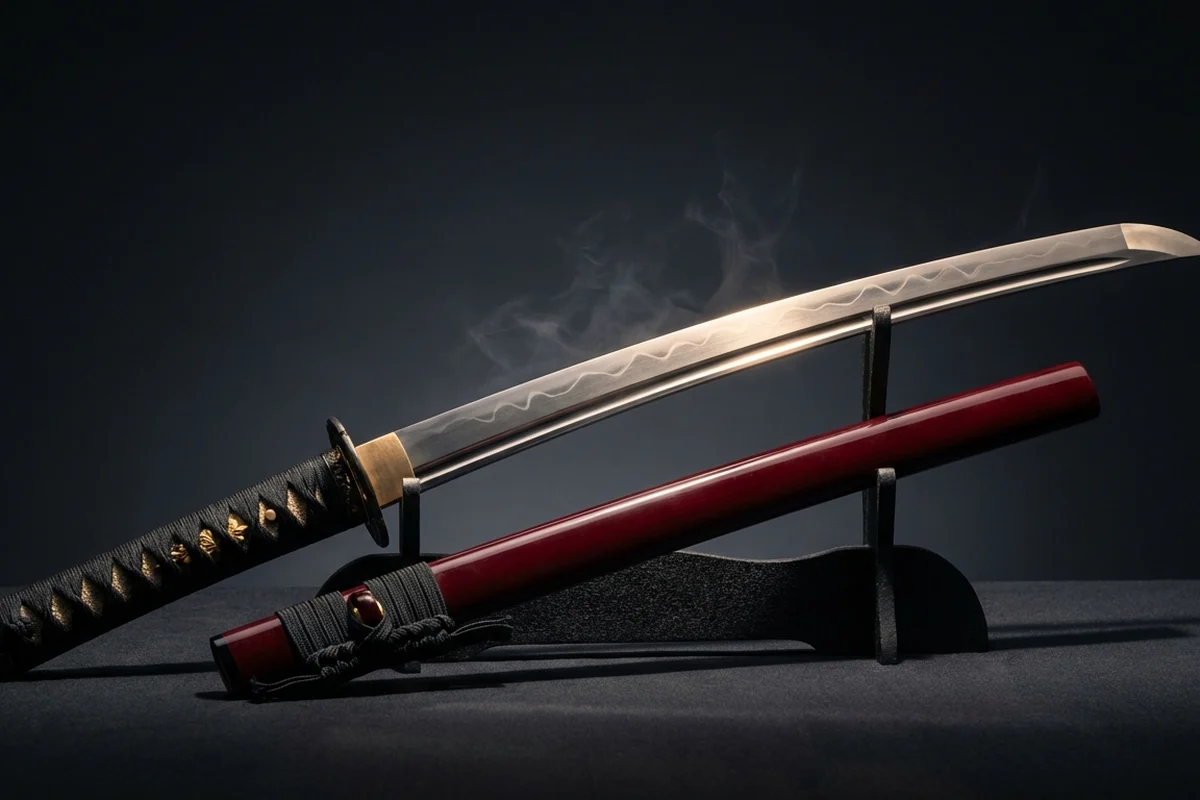
Few swords are as instantly recognizable as the katana. With its curved blade, distinctive fittings, and deep connection to Japan’s samurai era, the katana has become an enduring symbol of Japanese craftsmanship. Although it is often simply called a samurai sword, the katana is actually one member of a much broader family of traditional Japanese swords.
Today, interest in the Japanese sword extends well beyond historical study. Collectors, martial arts enthusiasts, anime fans, and people interested in Japanese culture all have different reasons for learning about these remarkable swords.
What Makes a Katana Different?
A traditional katana is generally recognized by its curved, single-edged blade and a handle long enough to accommodate two hands. Its shape distinguishes it from many straight European and Chinese swords, but blade geometry is only part of its identity.
The complete appearance of a katana also depends on its fittings. The tsuba serves as the guard, the tsuka forms the handle, and the saya is the scabbard. These components can range from simple and understated to highly decorative.
This variety explains why two katana swords with similar blade shapes can look completely different. Some collectors prefer traditional black fittings and natural themes, while others are attracted to dragon motifs, colorful saya, or contemporary designs.
Understanding Japanese Sword Types
The terms “katana” and “samurai sword” are sometimes used interchangeably, but Japanese sword traditions include several different blade types.
The wakizashi is shorter than a typical katana and was historically associated with the samurai as a companion sword. The tanto is shorter still and is generally categorized as a Japanese dagger. The older tachi typically has a more pronounced curvature and was traditionally worn differently from the later katana.
Longer Japanese blades, including the nodachi or odachi, represent another distinctive category.
Understanding these differences can make collecting more interesting because each Japanese sword has its own proportions, historical context, and visual character.
Steel and Katana Craftsmanship
Modern katana blades can be made from many different materials. Common examples include 1045, 1060, and 1095 high-carbon steel, as well as T10 tool steel, spring steel, folded steel, and other materials.
Steel type alone, however, does not determine the quality of a sword. Heat treatment, blade geometry, construction, polishing, fittings, and overall workmanship also matter.
Clay-tempered blades are particularly popular among collectors. Differential heat treatment can create a visible hamon, the characteristic pattern running along the blade near the cutting edge. Because hamon patterns vary, they can give individual swords a distinctive appearance.
Anyone comparing modern Japanese swords can browse specialist retailers such as TrueKatana at www.truekatana.com to see how different steels, blade styles, fittings, and traditional or modern designs are used across katana, wakizashi, tanto, and other sword categories.
Why the Samurai Sword Still Attracts Collectors
The modern popularity of the samurai sword comes from several directions. Historical enthusiasts appreciate its connection to Japanese culture and craftsmanship, while collectors often focus on blade materials, hamon patterns, tsuba designs, and other details.
Pop culture has introduced another generation to Japanese swords. Katana-inspired weapons appear throughout anime, manga, movies, and video games, encouraging fans to explore both fictional designs and their historical influences.
For new collectors, learning the terminology is often the best place to start. Understanding the difference between a katana, wakizashi, tanto, and tachi—and knowing how steel, heat treatment, fittings, and construction affect a sword—makes it easier to evaluate different options.
The katana has survived as a cultural icon because it represents more than a recognizable blade shape. It brings together Japanese history, craftsmanship, aesthetics, and modern popular culture, giving the Japanese sword an appeal that continues to reach collectors around the world.