

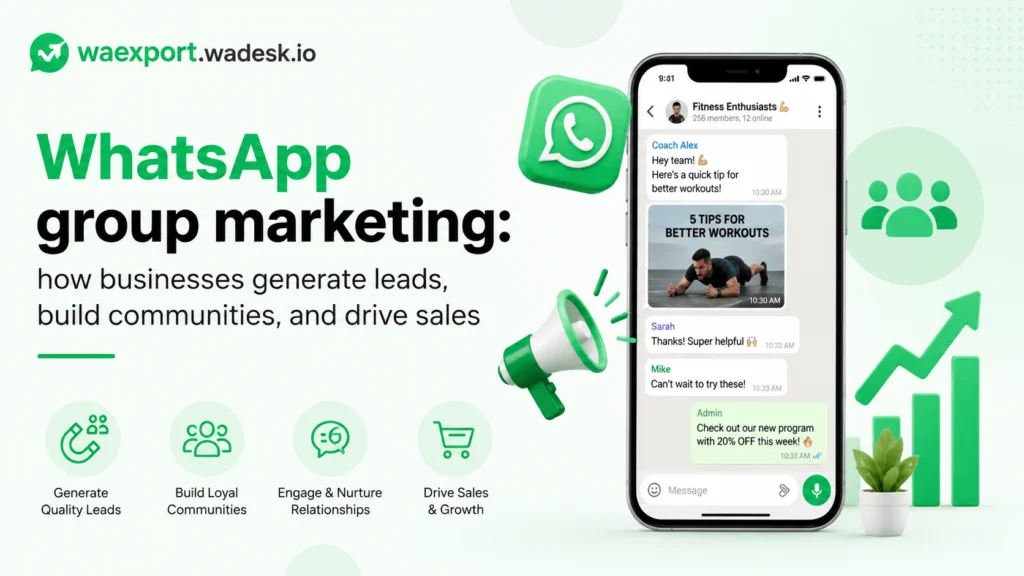
Three years ago, WhatsApp group marketing was something resellers did in their spare time. Now I’m watching cross-border ecommerce teams, B2B sourcing firms, and global agencies route real revenue through it. The math behind that shift isn’t subtle. WhatsApp hit roughly 3.5 billion monthly active users in early 2026, with around 800 million active groups across the platform, per DataReportal and Statista figures aggregated through Q1. Groups give you something paid ads can’t fake: warm prospects already gathered around a topic. The problem is that most teams still treat group marketing like email blasting with extra steps, then act surprised when accounts get banned in week two.
What is WhatsApp Group Marketing?
WhatsApp group marketing is the practice of finding, joining, or running WhatsApp groups to reach buyers, partners, and people inside a niche. Companies use it for lead generation, product drops, after-sales support, and community-led growth. Groups are many-to-many, not the one-way broadcast that lists give you. People talk back, signal intent, and leak useful context. That two-way visibility is why WhatsApp group search has quietly become a sourcing tactic on its own.
Why WhatsApp Groups Matter for Modern Customer Acquisition
Email reply times still hover around six hours. On WhatsApp, the average reply lands in 45 to 90 seconds. That gap is the whole game. Group chats also account for 41% to 57.5% of total message volume on the platform, according to Jesty CRM’s February 2026 statistics roundup. Conversational commerce conversion rates inside WhatsApp now run 45% to 60% in some verticals, up to twelve times what traditional channels manage. For sourcing-heavy industries like textiles or electronics, a single active buyer group can outperform a quarter of cold outbound.
How to Find and Join Relevant WhatsApp Groups
Most teams start with Google operators. Something like a site:chat.whatsapp.com “textile sourcing” will surface real public links. It works. It’s also slow. Faster routes I see teams actually using:
- Chrome extensions (WA Group Finder, Free WhatsApp Group Finder) for keyword scraping.
- AI-driven discovery platforms — WAGroup indexes 100,000+ groups across niches.
- Industry directories, Reddit threads, and trade-show pages with shared invite links.
- Customer referrals, which remain the single highest-quality source nobody talks about.
One warning: don’t bulk-join 200 groups in a day from a fresh number. That’s the fastest path to a permanent ban.
How Businesses Use WhatsApp Groups Strategically
Lead Generation and Prospect Nurturing
Sourcing teams sit inside niche buyer groups, watch for purchase signals, and pull warm conversations into DMs once they spot one. The group is the funnel top. Closing happens elsewhere.
Customer Onboarding and Activation
DTC and SaaS brands run small onboarding cohorts on WhatsApp instead of email drip sequences. Questions get answered in minutes. Activation rates climb. The downside is that it doesn’t scale past a certain headcount without automation.
Product Launch and Flash Sale Campaigns
Time-pressure offers work here in ways email can’t replicate. Tease the drop in the morning, post the actual link to your VIP groups by lunchtime, and watch it sell through.
VIP Customer Communities and Loyalty Programs
Sephora has driven appointment rates of up to 64% through WhatsApp concierge flows. Zara reported 43% conversion on VIP preview campaigns. You don’t need their budget to copy the structure. One or two carefully run groups will do it.
After-Sales Support and Repeat-Purchase Marketing
Replies inside Meta’s 24-hour service window stay free under 2026 pricing. That alone makes WhatsApp cheaper than email for support, reactivation, and the soft re-pitch around delivery confirmations.
Partner, Supplier, and Distributor Coordination
The least sexy use case and arguably the most valuable. B2B foreign trade firms run private distributor groups that replace whole email threads. Decisions move faster. Updates stop getting buried.
WhatsApp Group Engagement Best Practices
The point of all of this is that engagement, not reach, decides whether you keep your accounts. Christoph Mülner, founder of Chatarmin, summed it up in a March 2026 analysis: “WhatsApp marketing works best when brands treat it as a conversation channel, not a broadcast medium.” Practically, that means a few things. Open with personal context — referencing the group itself, not your product. Space your sends across the day instead of dumping everything in a ten-minute window. Rotate accounts and warm new numbers slowly (5 to 10 actions per day for the first week or two). Pin clear group rules and mute the self-promo crowd before they show up. And measure read rates, reply rates, and click rates, not just member counts.
WhatsApp Business API vs Standard WhatsApp
| Feature | WhatsApp / Business App | WhatsApp Business API |
| Best for | Solo founders, micro-shops | Teams, e-commerce, enterprise |
| Users per account | 1 device | Multi-agent shared inbox |
| Automation | Basic auto-replies | Chatbots, routing, CRM sync |
| Broadcast limit | 256 contacts | Unlimited opted-in |
| Throughput | Manual | Up to 500 msg/sec via Cloud API |
| Cost | Free | Per-message billing (since Jan 1, 2026) |
| Verification | None | Green tick eligibility |
Source: Meta Business Platform documentation and Wati’s February 2026 comparison guide.
Common Challenges in WhatsApp Group Marketing
Account bans are the loudest problem and the easiest one to cause yourself. Joining too many groups too fast, sending the same message everywhere, or hitting volume thresholds with a cold number all do it. Spam reports tank your quality rating, and Meta can suspend you with no warning. Beyond bans, you’ll fight dead groups full of bots, language fragmentation across markets, and the fact that the US is still pausing standard marketing templates in 2026 (Meta wants brands using MM Lite there). Privacy law adds another layer: GDPR in Europe, the DPDP Act in India, and LGPD in Brazil all make member scraping a real legal risk.
How to Measure WhatsApp Group Marketing ROI
Vanity metrics will lie to you here. The numbers worth reporting are reply rate, lead-to-DM conversion rate, cost per qualified lead, and 30-day repeat purchase lift. Tag every link with UTMs from day one, or you’ll never untangle paid from organic. If you’re running Click-to-WhatsApp ads, track that source separately. ROWS — return on WhatsApp spend — is the metric most teams should be putting in front of leadership.
Choosing the Right WhatsApp Group Marketing Platform
Pick based on what’s actually breaking. If you can’t find quality groups fast enough, the answer is an AI group finder. If you have lists but keep getting accounts banned, you need rotation, smart join-and-leave logic, and intent detection. WAGroup by WADesk handles both ends—AI discovery across 100,000+ groups, automated filtering, scheduled broadcasting, and real-time intent monitoring inside conversations. It’s free to start with no card. For the API side, layer in a proper BSP. That’s an actual stack, not three Chrome extensions duct-taped together.
Best WhatsApp Group Marketing for 2026
Three things I’d tell any team starting fresh. First, treat groups as conversation channels, not megaphones—reply rates are the entire game, and broadcast thinking will burn your accounts faster than anything else. Second, pair an AI WhatsApp group finder with disciplined sending hygiene. Doing one without the other guarantees a ban. Third, move serious automation to the Business API. The free app caps your team size and throughput, and you’ll outgrow it within a quarter once campaigns hit.
If you’re running cross-border e-commerce, B2B trade, or agency-side lead generation, start with WAGroup for discovery and safe broadcasting. The uncomfortable bit: if you’re still doing this work manually in 2026, somebody on your competitor’s team isn’t.
FAQs
Is WhatsApp group marketing legal?
Mostly, with a few hard rules. You can’t add people without consent. Meta’s Business Messaging Policy bans unsolicited promotional messages, and regional privacy laws apply. Stay opt-in, honor opt-outs fast, and classify your templates correctly, and you’ll be fine.
What’s the difference between a WhatsApp group and a WhatsApp channel?
Groups are two-way conversations with up to 1,024 people. Channels are one-to-many broadcasts with no member chat, similar to Telegram channels, and Meta’s product updates peg Channels at 500 million monthly users by mid-2024. Different tools, different jobs.
Can I scrape WhatsApp group members for marketing outreach?
You can, but it’s messy. Extensions exist that pull numbers from groups, but in jurisdictions with GDPR, India’s DPDP Act, or Brazil’s LGPD, those numbers count as PII. Intent-based outreach inside the group is safer and usually converts better than cold DMs to scraped contacts.
Which industries see the highest ROI from WhatsApp group marketing?
Cross-border e-commerce, B2B sourcing (textiles, electronics, and machinery), real estate, education, and Web3 communities consistently rank highest. The common thread is that their buying decisions involve back-and-forth conversation, not impulse clicks, and WhatsApp’s reply speed compounds across that dialogue.